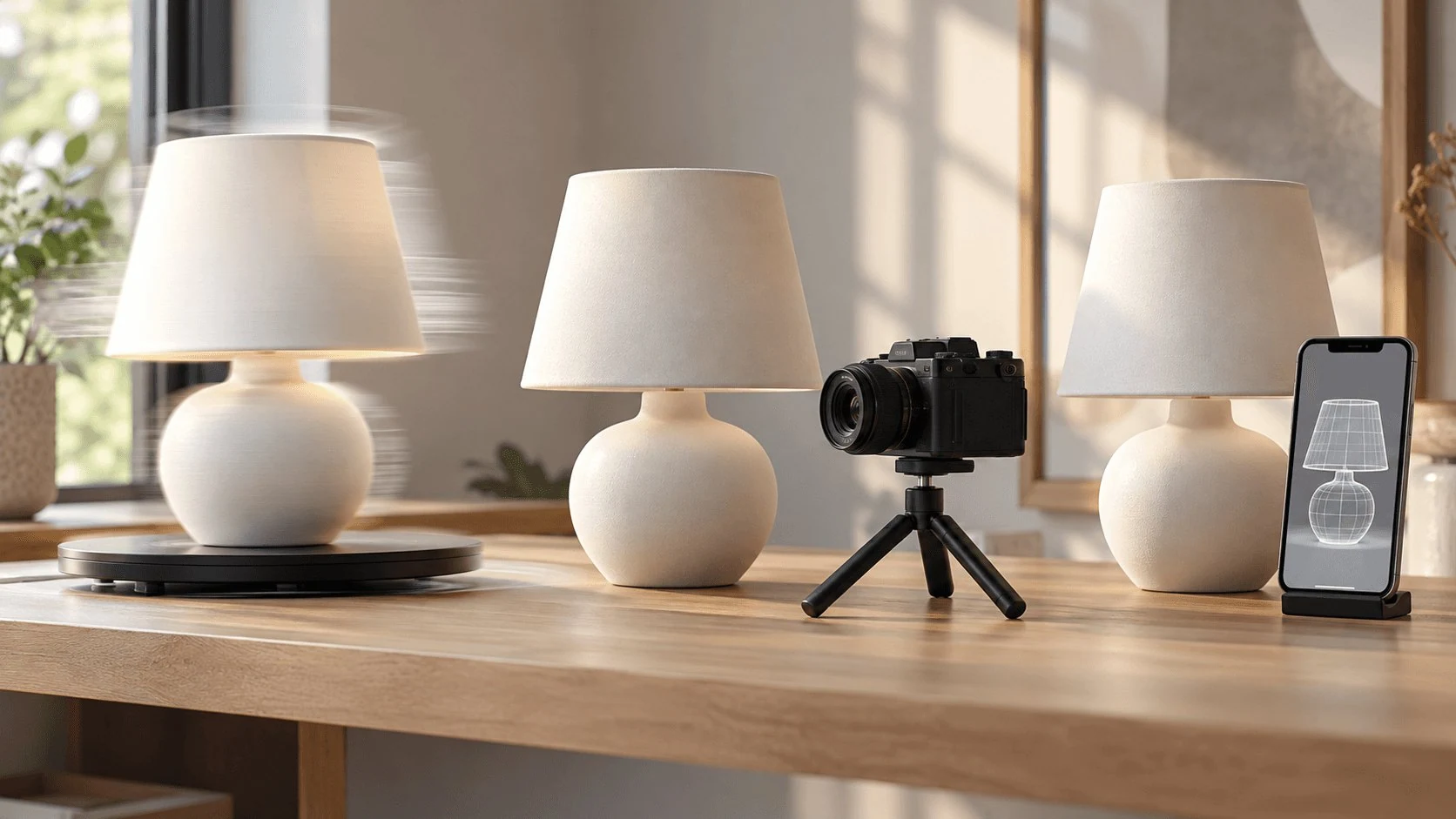
Most product pages can now carry a 360 degree spin, a product video or an interactive 3D viewer with augmented reality. Each costs a different amount of effort, and each comes with a different set of claims about what it does for sales.
This post compares the three, looks at the evidence behind the best known numbers, and is blunt about how weak most of it is. If you only remember one thing: almost every conversion figure you will see for 3D and AR comes from a platform or vendor that sells the technology.
01The three formats in plain terms
| Format | What the shopper does | What you need to make it | Main limit |
|---|---|---|---|
| 360 spin | Drags to rotate through a fixed set of angles | A set of photos or renders from evenly spaced angles | Fixed camera path, no zoom into the real geometry, no placing it in a room |
| Product video | Watches the product being used or shown | Filming or an animated render, plus editing and sound decisions | The shopper cannot choose the angle, and each variant may need its own clip |
| 3D / AR viewer | Rotates and zooms a real model, and on supported phones places it in their space | A web ready 3D model, usually in GLB and USDZ formats | Highest build effort, file weight, and device and platform support |
The effort ranking is not controversial. A spin is the lightest, video sits in the middle, and a proper 3D model is the heaviest to build and test. The open question is whether the extra effort pays back.
02What Shopify's 94% figure does and does not tell you
The most repeated number in this area comes from Shopify. Its changelog entry of 11 May 2022, announcing 3D and AR previews in the Shop app, says: "Merchants who add 3D content to their stores see a 94% conversion lift, on average." The post gives no sample size, time period or method.
There are good reasons to be careful with it:
- It compares merchants who added 3D with those who did not, and merchants who invest in 3D may already have better photography, better traffic and better products.
- It is an average, so a few large lifts can hide many small or zero ones.
- It covers "3D content" generally. It does not separate a viewer from AR, and it says nothing about which product categories were involved.
- It was published by the platform that wants merchants to use the feature.
None of this means 3D does nothing. It means the figure is a marketing average, not a forecast for your store.
03What Google says, and what it does not
Google's Merchant Center help page says 3D and AR products "often have strong customer engagement and receive more interactions" than products with 2D images. That is a statement about engagement, not sales, and the page gives no number. You may see a 50% engagement figure attributed to Google in other places, but I did not find it on the page I opened, so I am not repeating it.
The same help pages are more useful for their practical limits. The 3D model attribute covers home goods and shoes, and 3D and AR experiences are limited to products sold in the US, Canada, Australia, Japan and India. Google can also generate a spin from at least five photos, but that feature is currently listed for US merchants only, cannot offer AR, and takes up to two weeks to process.
04The best independent evidence is for video
For video there is a published randomized field experiment. Anuj Kumar and Yinliang Tan, in Management Science in 2015, added videos showing apparel with matching accessories for some randomly selected apparel items on a fashion retailer's website. They report a 14.5% increase in apparel sales and a 28.3% increase in accessories sales, with the accessories gain largely coming from spillover. The effect was also larger when videos ran alongside other promotions.
The limits are real. It was one retailer, one category and a style of video that showed outfits, and the data is now about a decade old. It does not say that any video on any product page will lift sales by that much, and it did not test spins or 3D.
For 360 spins and AR viewers, I found no independent controlled test of purchases. The spin and AR figures I came across were published by companies that sell those tools.
05How the evidence stacks up
| Format | Best evidence found | How much to trust it |
|---|---|---|
| Video | Randomized field experiment, one fashion retailer, 2015 | Reasonable for apparel video; not transferable to other categories without testing |
| 360 spin | Only vendor quoted figures found | Low. No independent test found |
| 3D / AR viewer | Shopify 94% average (2022); Google engagement statement | Low. Platform claims with no published method |
06How to choose for your products
Start from what your shopper cannot work out from still photos, not from what is fashionable.
- Shape and size are the doubt (furniture, appliances, bags): a 3D viewer with AR answers the question directly. Make sure the model is to true scale, or AR can mislead.
- Use and feel are the doubt (a tool, a kitchen gadget, a garment): video shows motion and context better than any rotation.
- Look from all sides is the doubt (headphones, bottles, small electronics): a spin is often enough and is the cheapest to produce.
- Mostly mobile on slow connections: if analytics show most traffic is on mobile over slow connections, a heavy 3D model may hurt more than it helps.
Shopify's help page says 3D models are accepted as GLB and USDZ files up to 500 MB, and that files over 15 MB are optimized automatically. Treat the smaller number as a quality target, because page weight affects every visitor, not only those who open the viewer.
We have written about video on marketplace listings in does a product video on Amazon increase sales, and about the wider shift to interactive product pages in what is spatial commerce.
07Test it on your own pages
Given how thin the independent evidence is, your own test beats any benchmark. Pick six to ten comparable products and give them one format each, leaving the rest as the control. Run the test for several weeks and across a full sales cycle, not just a sale weekend.
Track add to cart rate, conversion and return rate for each group. Return rate matters because a viewer that raises sales but also raises returns may not be a gain. Keep price, ad spend and the main photos unchanged during the test.
08How Smapit can help
Smapit is a Gurugram based studio that builds 3D models, product renders, animations and ecommerce listing content for brands in India, the US and the UAE. A single 3D model can be used to produce stills, a spin, a video and a web ready viewer, so you can test formats without starting from scratch each time. You can request a free sample through the contact page, and see our 3D product animation and product rendering pages for what each involves.
09Frequently asked questions
Does a 3D or AR viewer increase conversion by 94%?
Shopify's May 2022 changelog says merchants who add 3D content see a 94% conversion lift on average, but it gives no sample size or method. It is an average across merchants who chose to add 3D, so it cannot be read as the effect you will get.
Is product video better than a 360 spin?
No published head to head test that I could find settles it. The strongest independent evidence is for video, in a randomized field experiment at one fashion retailer, but that study did not test 360 spins.
What is the cheapest of the three to produce?
A 360 spin built from a set of photos or renders usually needs the least new work, and Google can generate a spin from at least five photos for US merchants. A web ready 3D model with AR needs a proper 3D asset and the most checking.
Can I show 3D models in Google results from India?
Google's Merchant Center page lists India among the countries for 3D and AR experiences, but the 3D model attribute applies to home goods and shoes. Check the page for current rules before you build.
How should I test which format works for my products?
Run a split test on a few comparable products, one format per group, and track add to cart rate, conversion and return rate for several weeks. Keep price, traffic source and photos otherwise the same.
Sources: Shopify Changelog, "Shop adds 3D and augmented reality (AR) previews," 11 May 2022; Shopify Help Center, "Product media types"; Google Merchant Center Help, "Display your products in 3D and augmented reality" and "Use Google AI to display your products in 360 spin"; Kumar, A. and Tan, Y., "The Demand Effects of Joint Product Advertising in Online Videos," Management Science 61(8), 2015, pp. 1921 to 1937.
Planning something like this?
Talk to Smapit