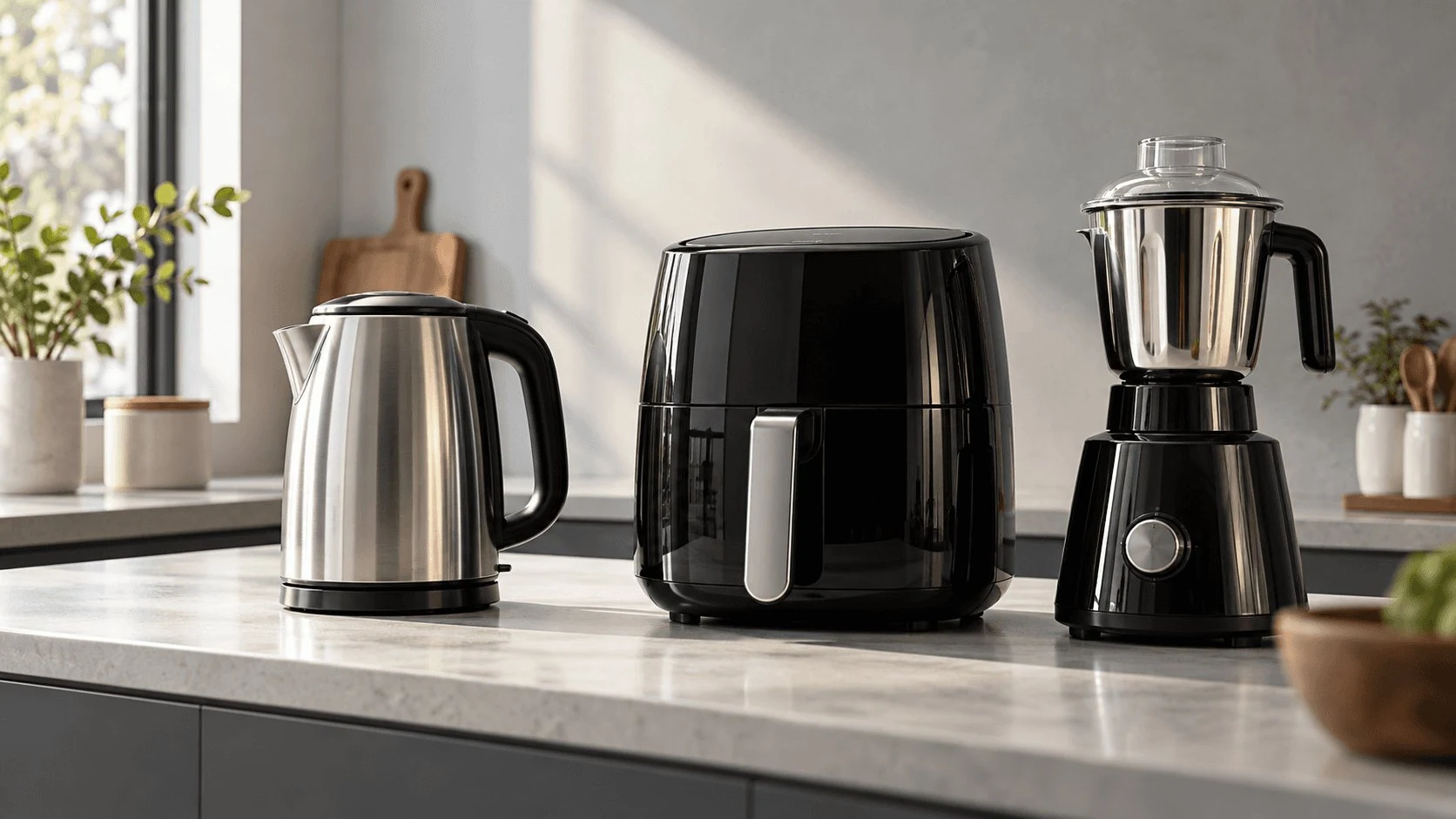
A brushed steel kettle, a glass lidded air fryer and a mixer grinder with a chrome trim jar all have the same problem: they reflect everything around them. The product page needs them to look clean, accurate and different from the next brand's, on a small phone screen, in several colors.
This post is for home and kitchen appliance brands in India. It covers the market context we could verify, why these products are hard to photograph, what CGI does well for them, and the jobs that still need a real camera.
01The market behind the product page
India's consumer durables sector is expected to reach about Rs 3 lakh crore by FY29, according to figures compiled by IBEF, the India Brand Equity Foundation, which also cites an 11% compound annual growth rate for the sector. Small kitchen appliances are a much smaller slice, and published estimates for them vary because research firms define categories differently.
Two category estimates are worth knowing, both from market research firms and both estimates, not audited sales:
- Mixer grinders: MarkNtel Advisors puts the market at USD 0.541 billion in 2025, growing about 5% a year to 2032, and says online accounts for roughly 70% of the market in 2026. It also says the top five brands hold nearly 55%.
- Air fryers: IMARC Group estimates USD 48.8 million in 2025, growing at 5.57% a year to 2034. Other firms publish much larger figures (Persistence Market Research puts 2026 at about USD 320 million), which shows how far category definitions differ.
I could not find a verified online share figure for kettles, fans or lighting. If a mixer grinder is mostly bought online, the product images carry much of the selling. That is the case for investing in them, but it is an inference from one firm's number, not a measured rule.
02Why steel, glass and gloss are hard to photograph
Polished metal and glass behave like mirrors. A photography studio's guide on reflective products puts it plainly: reflective surfaces pick up everything, so lights, equipment, the photographer and the camera can show up in the picture. The goal is not to remove reflections but to decide what reflects and where.
Photographers have standard tools for this, including light tents for soft all round light, cross polarizing filters, black flags to block unwanted reflections and white cards for fill. They work, but each setup takes time, and a tent can make a product look flat. Every new finish, angle or glass element needs its own tuning.
For appliances this multiplies fast. A mixer grinder has a steel jar, a plastic body, a lid with a window and a lit control panel. An air fryer adds a glossy front, a handle and a basket. Photographing each correctly, in three colors, from six angles, for twenty SKUs, is where cost and consistency start to slip.
03What CGI changes for appliances
In CGI the lighting studio is virtual. The artist places large soft light panels, dark panels and white cards in software, then controls what each curved surface reflects. Nothing is physically in the way, so there is no camera or tripod to hide, and the same lighting setup can be reused across every product in a range, which helps with consistency.
Materials are built to match the real product: brushed or polished steel, glass, matte and gloss plastic, rubber feet, an LED display. This is where the work is judged, so ask for a test render on one of your products and compare it with the unit on your desk. Our product rendering and 3D product modeling pages describe how we work.
04Exploded views, feature views and color variants
Three kinds of image are hard to get from a camera and straightforward from a model.
- Exploded views. Jar, blade, gasket and lid separated in space, or air fryer basket, tray and heating element shown in order. They explain the product at a glance and need accurate internal geometry, so supply the manufacturer's CAD where you can.
- Feature views. A cutaway of a kettle's cutoff switch, the angle of a fan blade, or the spread of light from a lamp. These show what a normal photograph cannot.
- Color and finish variants. Once the model exists, a new color is a material change, not a new shoot. This matters for fans, mixers and kettles sold in several finishes.
A note on marketplace rules. Marketplaces restrict main images, and Amazon's are generally described as a plain white background with the product filling most of the frame and no added text or props. We could not confirm the exact numbers on an official Amazon India page, and third party sources disagree on minimum pixel sizes, so check Seller Central before you brief anyone. Exploded and feature views therefore belong in secondary images and A+ content.
One more constraint: a render must match the real product. Rule 5(2) of India's Consumer Protection (Ecommerce) Rules, 2020, as summarized by IndiaLaw and other commentary, requires marketplaces to obtain an undertaking from sellers that descriptions and images are accurate and match the appearance, nature, quality and features of the goods. A render that shows a nicer finish, a bigger jar or a feature the product lacks is a risk, not only a quality problem.
In practice: build the model from the actual product or its design files, check the render against a physical unit, and have someone from product or quality sign off on colors, dimensions and labels before launch.
05Which appliances suit CGI, and which suit a camera
The table below is our editorial judgment from the factors above, not a measured result.
| Product | Main difficulty | CGI fit | Photography still needed for |
|---|---|---|---|
| Mixer grinder | Steel jar, chrome trim, many jars and colors | Strong: variants, exploded jar and blade views | Food in the jar, hands using it |
| Air fryer | Glossy front, glass or display, internal parts | Strong: internal views, color variants | Cooked food results, real kitchen use |
| Electric kettle | Steel and glass, water level, lit base | Strong for clean and feature shots | Pouring, steam, water behavior |
| Ceiling or table fan | Large size, thin blades, finishes | Strong for finishes and room scale scenes | Real installations, airflow demonstration |
| Lighting | Light output and color are the product | Good for fixtures and ranges | Real light quality in real rooms |
06Where real photography is still the better choice
CGI shows what a product looks like. It is weaker at showing what happens when a person uses it. Food results from an air fryer, steam from a kettle, a family in a kitchen, and the actual color of warm light on a wall are better photographed, or filmed. Customer reviews and creator videos carry weight because they are real, and rendering them would defeat the point.
A practical hybrid is to render the product images, color variants and technical views, and shoot a smaller set of lifestyle and in use photos. Our comparison of CGI versus product photography and the guide to CGI product images on Amazon and Flipkart cover the tradeoffs further.
07What to send a studio for appliance work
- CAD or 3D files, or a physical sample with clear photos from all sides
- Exact color references for every variant, such as paint codes or physical swatches
- Material and finish details: brushed or polished, matte or gloss
- Dimensions, jar or basket capacities, and the labels and icons to appear
- The marketplace image rules you need to meet
08How Smapit can help
Smapit is a Gurugram based studio that builds 3D models, product renders and ecommerce listing content for brands in India, the US and the UAE. If you sell appliances and want to see how your product looks as a render, request a free sample through the contact page and compare it with your current photos.
09Frequently asked questions
Why are stainless steel appliances hard to photograph?
Polished steel and glass act like mirrors, so lights, equipment and the camera can appear in the picture. Photographers control this with diffusion, flags and filters, but it takes time to set up for each product and finish.
Can CGI show the inside of a mixer grinder or air fryer?
Yes, as exploded or cutaway views, if the model is built from accurate internal design data. Ask your manufacturer for CAD files where possible.
Can I use rendered images as the main image on Amazon India?
Marketplaces generally want a plain white background and a clean product only main image, and a render can meet that. We could not verify Amazon India's exact numbers from an official page, so confirm the current requirements in Seller Central.
Do rendered images have to match the real product?
They should. Under Rule 5(2) of India's Ecommerce Rules, 2020, marketplaces must require sellers to undertake that descriptions and images are accurate, so check colors, sizes and features against a physical unit.
Which appliance content still needs a photoshoot?
Anything showing human use or real results, such as food from an air fryer, steam from a kettle or warm light in a real room. A common approach is to render the product and shoot a small lifestyle set.
Sources: IBEF (India Brand Equity Foundation), Consumer Durables industry presentation (accessed October 2026); MarkNtel Advisors, India Mixer Grinders Market Study, September 2026; IMARC Group, India Air Fryer Market, updated 17 September 2026; Persistence Market Research, India Air Fryer Market; Squareshot, "Reflective surface product photography," 19 June 2026; IndiaLaw, "A summary of the Consumer Protection (Ecommerce) Rules, 2020."
Planning something like this?
Talk to Smapit